

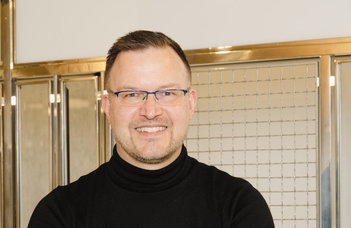
Christoph Schwanda (Marietta Blau Institute, AAS, Austria)
2026. szeptember 24. 15:00 - 2026. július 24. 16:00
ELTE Lágymányos Campus, Northern Building, 1.71 (Pócza lecture hall)
2026. szeptember 24. 15:00 - 2026. július 24. 16:00
ELTE Lágymányos Campus, Northern Building, 1.71 (Pócza lecture hall)
The Belle II Experiment at the SuperKEKB Collider: Exploring Physics Beyond the Standard Model with Precision
Abstract: Ordinary matter constitutes only about 5% of the universe's energy content, leaving the nature of the remaining 95% unexplained by the Standard Model of particle physics. This cosmological evidence stands in stark contrast to experimental results from particle collider experiments, where all observed phenomena are consistently described within the Standard Model framework. This dichotomy presents a profound challenge for modern particle physics, and precision frontier experiments may hold the key to resolving it. Historically, evidence for new particles—such as the charm quark, the top quark, or the Higgs boson—has first emerged in precision data before being confirmed through direct production in high-energy collisions.
In this talk, I will provide an overview of the Belle II experiment at the SuperKEKB collider, highlighting its current status, the challenges it faces, and the ways in which the decays of B and D mesons can shed light on physics at higher energy scales. I will also discuss the planned upgrade for 2032/33 and explore how innovative experimental approaches will further extend the experiment's capabilities.
About the lecturer: Christoph Schwanda (b. 1973) is a distinguished particle physicist and a member of the Belle/Belle II collaborations since 2001. He currently serves as the deputy director of the Marietta Blau Institute of Particle Physics at the Austrian Academy of Sciences. Schwanda graduated from the Vienna University of Technology in 1998 and earned his Ph.D. at the DELPHI experiment on the LEP collider at CERN. Following his doctoral studies, he joined KEK, Japan's premier particle physics laboratory, as a postdoctoral fellow under the Japan Society for the Promotion of Science.
Since 2006, Schwanda has led a research group focused on Belle/Belle II at the Austrian Academy of Sciences. He has held numerous leadership roles within the collaboration, including coordinating research on semileptonic B meson decays and overseeing the construction of the Silicon Vertex Detector for the Belle II upgrade in 2018. Currently, he serves as the Belle II coordinator for the 2032 upgrade.
In addition to producing significant Belle/Belle II research results with his team, Schwanda is a contributing author to the "Review of Particle Physics" (PDG) and co-authored the section on Cabibbo-Kobayashi-Maskawa matrix elements V_ub and V_cb in the book "Physics of the B-Factories", alongside Vera Luth (Stanford University).
Photo credits: Luiza Puiu.